Why Commercial Buildings Need Annual Infrared Electrical Inspections
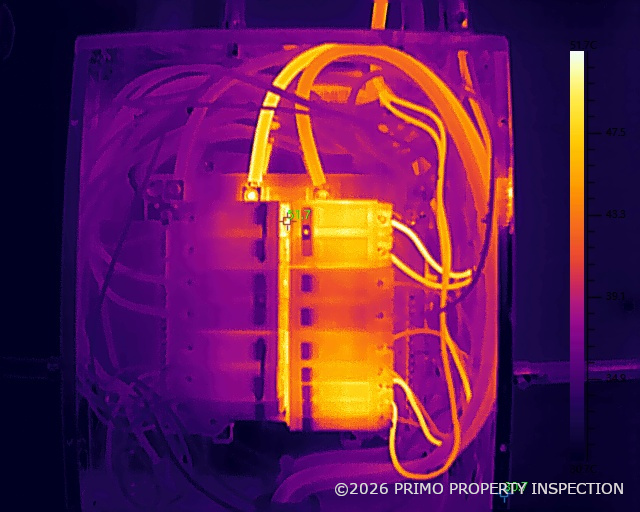
Electrical fires are consistently among the leading causes of commercial building fires in the United States. What makes them particularly destructive is that virtually all of them are preceded by detectable warning signs - heat anomalies at connections, panels, and conductors that build over months or years before anything visible fails. The problem is that those warning signs are invisible to standard visual inspection. You need a thermal camera to see them.
Annual infrared thermographic inspection of electrical distribution equipment is the most effective tool available for detecting these conditions before they become fires. And with the 2023 revision to NFPA 70B, what has long been best practice is now codified as a formal maintenance requirement for commercial buildings.
What Infrared Thermography Reveals
A thermal camera measures surface temperature across an entire panel or piece of equipment in a single scan. Heat that would be completely invisible during a standard visual inspection - inside a breaker, at a bus bar connection, along a conductor - registers clearly as a temperature differential against the surrounding equipment.
The conditions that thermal scanning reliably detects include:
- Loose or corroded connections: Any resistance at a connection point generates heat under load. A loose lug on a 100-amp circuit may show a temperature differential of 20, 40, or 80 degrees above ambient - a clear indicator of a connection that needs to be re-torqued or replaced before it arcs.
- Overloaded circuits and conductors: A conductor running above its rated ampacity will run hot uniformly along its length. This is visible on a thermal scan as a warm conductor relative to adjacent circuits and is a direct indicator of either undersized wiring or a circuit being used beyond its design capacity.
- Failing breakers: Circuit breakers that are failing internally often show elevated temperature at the breaker body under load, even when they have not yet tripped. These breakers may trip nuisance-free for months while slowly deteriorating toward a condition where they fail to trip when needed.
- Phase imbalance: In three-phase systems, all three phases should be running at roughly equal temperatures under balanced load. A significant temperature differential between phases indicates an imbalance condition that stresses equipment and often reflects an upstream problem in load distribution.
- Neutral issues and bus bar anomalies: Loose neutral connections are among the most dangerous electrical conditions in a commercial panel. A floating neutral under load can result in voltage swings that damage equipment and create shock hazards. Thermal imaging frequently identifies neutral connection anomalies that would otherwise go undetected until something fails.
NFPA 70B and the 2023 Revision
NFPA 70B, the Standard for Electrical Equipment Maintenance, has been the governing document for commercial electrical maintenance programs for decades. For most of its history, 70B was a "Recommended Practice" - its language was advisory, using "should" rather than "shall," and compliance was largely driven by insurance requirements and individual risk tolerance rather than formal code adoption.
The 2023 edition changed this fundamentally. The revision converted NFPA 70B from a recommended practice into a mandatory standard, with "shall" language replacing the advisory "should" throughout the document. This shift has significant implications: where 70B is adopted by a jurisdiction's electrical or fire code - as it has been in a growing number of California municipalities - its requirements are now enforceable, not merely advisory.
Specifically relevant to infrared scanning, the 2023 edition of NFPA 70B establishes explicit requirements for thermographic inspection as part of a compliant electrical maintenance program. The standard requires that electrical distribution equipment - switchgear, panelboards, motor control centers, and similar equipment - be subject to infrared thermographic inspection on a defined maintenance interval. For most commercial buildings under normal operating conditions, the standard supports an annual inspection frequency as the appropriate baseline interval, with more critical facilities potentially requiring more frequent scans.
The practical effect for commercial property owners and managers is that annual infrared electrical inspections are no longer just a good idea or an insurance requirement - they are part of a formally documented maintenance standard that authorities having jurisdiction can enforce.
Why Electrical Panels Are Particularly at Risk in Bay Area Buildings
Bay Area commercial buildings present several factors that elevate electrical risk beyond what you'd see in newer construction:
Age of electrical infrastructure. A significant portion of the Bay Area's commercial building stock was constructed between the 1950s and 1980s. The electrical distribution equipment in these buildings - panels, switchgear, bus duct - is often original or has been partially updated over the decades without full modernization. Equipment at this age has been through thousands of thermal cycles, may have accumulated corrosion at connection points, and may have been subjected to modifications by multiple tenants and contractors over its service life.
Tenant-driven load changes. Commercial tenants routinely add electrical loads - additional HVAC equipment, kitchen equipment, server rooms, EV charging infrastructure - that were not anticipated in the original electrical design. This creates circuits running at or above their rated capacity, and it creates situations where panels are operating in ways their original designers did not intend. Thermal scanning documents the actual operating condition of the electrical system under real-world tenant loads.
Deferred maintenance. Electrical panels don't make noise when something is wrong. Unlike a failing HVAC system that affects tenant comfort immediately, a panel with deteriorating connections can operate for years without anyone noticing - until it doesn't. The absence of visible or audible symptoms is what makes annual thermal inspection so valuable: it creates a regular opportunity to find problems during their slow-developing phase, before they reach the acute failure point.
How the Inspection Is Performed
An infrared electrical inspection requires that the equipment be energized and under load - thermal differentials are only meaningful when current is flowing. This distinguishes the inspection from a standard visual panel review and requires qualified personnel who are trained to work safely around energized electrical equipment.
The inspection covers all accessible electrical distribution equipment: main switchgear, distribution panels, sub-panels, motor control centers, and visible conductors at termination points. Each panel is scanned with the cover open (or through an appropriate infrared-transparent window where available), and temperature readings are documented for each circuit and connection point.
Findings are classified by severity - typically following a priority system based on the degree of temperature differential, which correlates to urgency of remediation. A connection running 10 degrees above ambient is a monitoring item; a connection running 80 degrees above ambient at a main distribution lug is an emergency.
The deliverable is a written report with thermal and visible-light images of each finding, temperature data, severity classification, and recommended action. This report becomes part of the building's maintenance record and supports insurance documentation requirements.
Insurance Implications
Commercial property insurers have required annual infrared electrical surveys for many years - often as a condition of coverage for older buildings or buildings with heavy electrical loads. The 2023 NFPA 70B revision aligns the formal maintenance standard with what the insurance industry has long recognized as necessary practice.
For property owners who have been performing annual surveys, the 2023 revision is confirmation that their practice is correct. For those who have deferred this inspection, the revision is a signal that the gap between best practice and formal requirement has now closed. Insurance carriers increasingly request documentation of completed infrared surveys during policy renewals, and buildings without current survey documentation may face coverage questions or premium adjustments.
Integrating Infrared Inspection Into Your Maintenance Program
An annual infrared electrical inspection is most valuable when it is part of a broader electrical maintenance program rather than a standalone event. The inspection identifies conditions; the maintenance program ensures they are remediated and tracked over time. Together, they create a documented record that demonstrates due diligence - to insurers, to regulators, and to future buyers when the property eventually transacts.
For commercial property owners and managers who want to understand the condition of their building's electrical infrastructure, infrared thermographic inspection is the place to start. If you're in the middle of an acquisition and want to know what you're buying, or if you're managing an existing portfolio and need to establish a baseline for deferred maintenance, a thermal scan of the electrical distribution system is one of the highest-value inspections you can commission.