Thermal Roof Scans & Impedance Testing: Why Both Matter
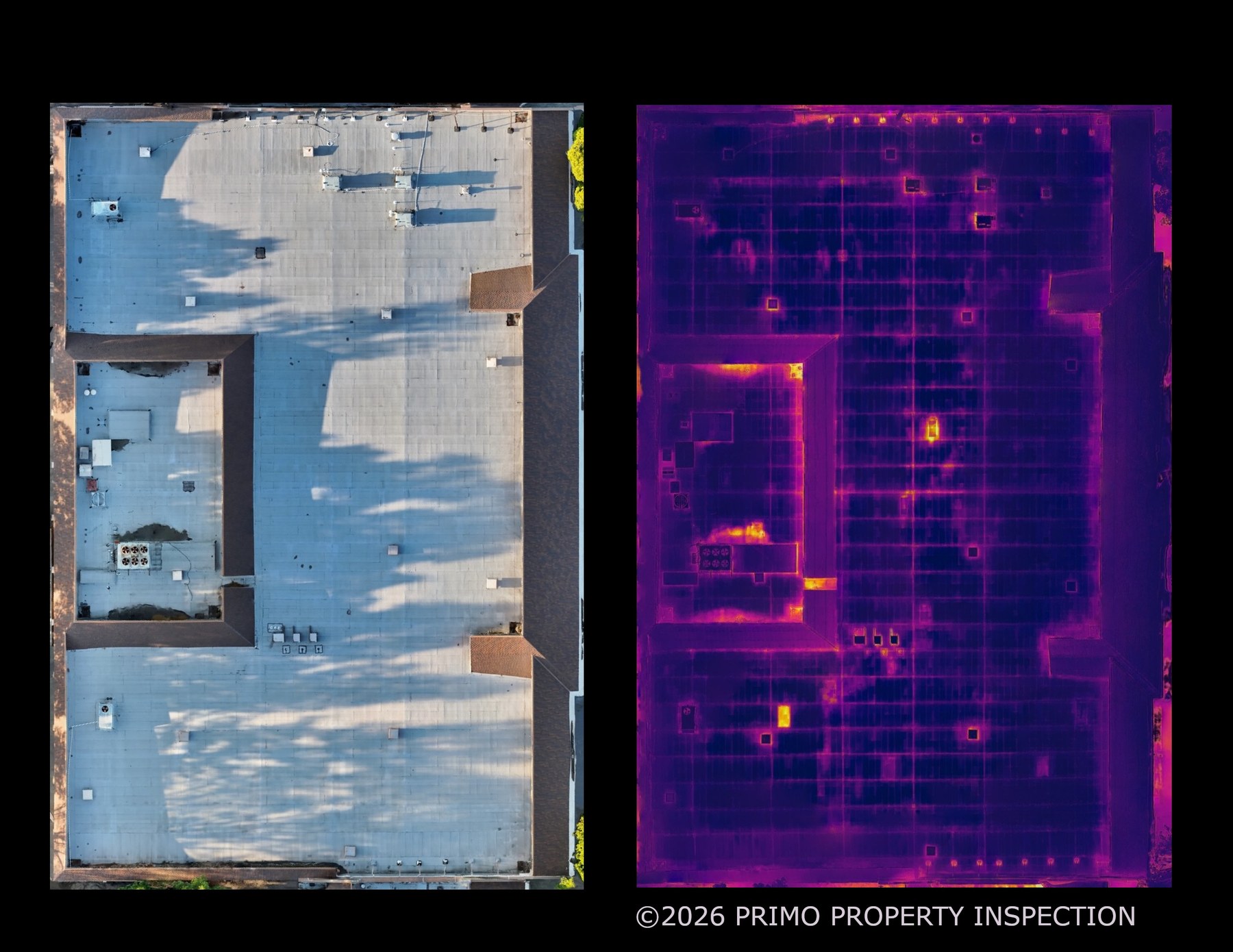
Of all the deferred-maintenance problems that hide in plain sight, trapped roof moisture is the most expensive to ignore and the hardest to see. Insulation can be saturated for years underneath an intact-looking membrane, quietly losing thermal performance and degrading the deck below, before it ever produces a visible leak inside the building. By the time water is dripping from a ceiling tile, the moisture has usually already spread well beyond the point of entry.
Two ASTM standards govern how professionals find that trapped moisture before it becomes a structural problem: infrared thermography under ASTM C1153, and electrical impedance scanning under ASTM D7954. They're often treated as interchangeable - pick one, run the scan, done. In practice, they're complementary tools that catch different things, and relying on only one leaves real gaps.
Two Standards, Two Methods
ASTM C1153 governs infrared (IR) roof moisture surveys. The method relies on a simple physical principle: a roof surface absorbs solar heat during the day, and at night it radiates that heat back out. Wet insulation retains more heat than dry insulation, so as the roof cools after sunset, areas with trapped moisture stay measurably warmer than the surrounding dry areas - a thermal signature an infrared camera can capture from a walking survey or a drone flight. The standard is strict about conditions: no appreciable precipitation for at least 24 hours before the survey, and a large enough day/night temperature swing to produce a usable thermal contrast. Done correctly, IR can cover an entire roof quickly and non-destructively, which makes it the right first step for triaging a large or unfamiliar roof.
ASTM D7954 governs a different method: electrical impedance scanning. Instead of reading heat, an impedance scanner is walked across the roof surface in physical contact, measuring the electrical conductivity of the roofing assembly. Wet insulation conducts differently than dry insulation, so the scanner can localize moisture directly, using either a continuous scanning technique or a grid-pattern technique depending on the roof. Because it doesn't depend on solar heating, time of day, or a specific weather window, impedance scanning can be performed under conditions where IR isn't practical - and its contact-based readings tend to be more precise at pinpointing the actual boundary of a wet area.
Why One Method Alone Isn't Enough
Infrared thermography is fast and covers a lot of roof area efficiently, but it has known failure modes. Rooftop equipment, HVAC curbs, and ballast can retain or reflect heat in ways that mimic a moisture signature - a false positive. Parapet walls and other roof features can shadow adjacent areas and mask a real signature - a false negative. Because IR only measures a surface effect, it also can't directly confirm how deep or how saturated the moisture actually is; it identifies suspect zones that still need to be verified.
Impedance scanning solves several of those problems - it's unaffected by solar loading or equipment thermal mass, and its localized readings are harder to fool - but it's slower to cover a large roof exhaustively on its own, since it depends on physically walking a scan pattern across the whole surface rather than capturing wide areas at once.
Used together, the two methods cover each other's blind spots: an infrared survey quickly identifies where the suspect zones are across the whole roof, and impedance scanning verifies and precisely delineates those specific zones with a method that isn't vulnerable to the same false positives. That combination is what actually satisfies the intent of both standards - C1153 explicitly notes that infrared identifies zones of suspected moisture that should be confirmed, and pairing it with a contact-based method like impedance scanning (or destructive core sampling) is exactly that confirmation step.
What This Prevents
Catching trapped moisture early is almost entirely about avoiding compounding damage. Wet insulation loses R-value, which quietly increases HVAC energy costs for as long as it goes unaddressed. Left long enough, sustained moisture degrades the roof deck itself - turning what would have been a targeted insulation and membrane repair into a structural remediation project. Trapped moisture is also a common precursor to mold growth in the building envelope, and it accelerates membrane failure well ahead of a roof's expected service life, often forcing a premature full tear-off instead of a repair.
All of it fits the same pattern as deferred maintenance generally: a small, containable problem gets expensive fast the longer it goes undetected.
When to Schedule This
A combined moisture survey is most valuable in a handful of specific situations: after a major storm event, on roofs approaching the end of their manufacturer warranty, as part of pre-acquisition due diligence on any building with a low-slope roof, and before committing to a re-roofing scope - where the survey determines which sections actually need replacement versus which are still performing.
Primo performs both methods together as standard practice on every roof moisture survey - not as an optional add-on. The infrared scan, performed to the C1153 methodology, identifies suspect zones across the roof efficiently; electrical impedance scanning per ASTM D7954 is then used to verify those findings directly, confirming and precisely mapping the boundaries of any trapped moisture the infrared survey flags. Pairing the two methods on every survey is what keeps the results defensible - a finding backed by both a thermal signature and a contact-verified impedance reading is a much harder thing to dispute during negotiation or underwriting than a thermal image alone. Findings from both methods are cross-referenced with the core inspection report.